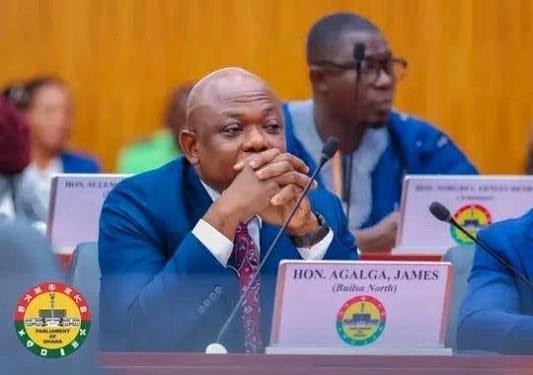
The Majority Leader, James Agalga, has welcomed the Minority’s call for a bipartisan investigation into alleged losses incurred under the Domestic Gold Purchase Programme (DGPP), insisting, however, that the scope of the probe must be extended to cover the gold purchase activities undertaken under the previous administration.
This, he said, should bring “finality to the matter”.
In his view, the government was interested in knowing the true nature of the reported losses and determining whether they represented actual financial losses or operational expenditure incurred in implementing the programme.
Let’s establish facts
Addressing a concern by the Minority Caucus after presenting the Business Statement in Parliament last Friday, Mr Agalga said there were contradictory claims about the reported losses, making a broader investigation necessary to establish the facts.
“Once again, this is a matter that we are equally very interested in, because there have been contradictory claims,” he said.
He said this in response to the Minority Leader, Alexander Afenyo-Markin, who pressed Parliament to conduct bipartisan investigations into GoldBod and the Bank of Ghana gold trading operations covering 2025.
The Minority Leader, Alexander Afenyo-Markin, called on Parliament to take up a pending motion seeking an investigation into alleged losses associated with the domestic gold purchasing programme.
He said Ghanaians deserved a full explanation as GoldBod reported a surplus from its gold-purchasing activities while the Bank of Ghana recorded substantial losses arising from the same programme.
He said the apparent contradiction raised serious questions about the management of the programme, the accounting treatment of its transactions and the institutions or individuals responsible for the financial outcomes.
“Ghanaians are entitled to know where the losses sit. Who authorised the transaction and who will answer for them?” he asked.
Broaden investigation scope
Responding, Mr Agalga explained that while the Minority held a different position on the reported losses, the Majority believed that the GoldBod had actually reported operational losses, a position which was reinforced by the Auditor-General’s report.
“Our views are reinforced by the Auditor-General’s report and so if they want such a motion to be taken, we are ready,” he stated.
He, however, said the Majority Caucus would insist that the scope of the proposed investigation be broadened to include gold purchasing activities undertaken when the previous administration was in office.
“But once again, we shall insist that the scope of that motion is broadened so that at the time we engaged in gold purchases, even when they were in power, we would be looking into it so that we would see or we would try to understand whether the so-called losses are operational expenditure or they are real losses,” he said.
Mr Agalga also questioned whether similar operational costs incurred under the previous administration had also been classified and reported as losses.
In his view, a comprehensive investigation would help settle the conflicting positions surrounding the programme and provide clarity on the financial implications of the gold purchasing operations.
“We shall look into that motion too so that those matters are brought to rest once and for all,” he assured the House.
Passport director’s interdiction
The Leader of Government Business also said Parliament could invite the Foreign Affairs Minister to brief the House on investigations involving the interdicted Director of Passports, Mr Alhassan Mahama.
He said the interdiction was intended to allow investigations into the matter to proceed, and the Foreign Affairs Minister was willing to appear before the appropriate parliamentary committee to provide an update.
The Minority Leader had earlier called for the Foreign Affairs Minister to be scheduled to appear before Parliament to explain the circumstances surrounding the interdiction of the Director of Passports.
He argued that the matter was of considerable public interest and that the minister should account to the people’s representatives rather than confine himself to his executive responsibilities.
Source: Graphiconline