The Minority in Parliament has launched a blistering attack on President John Dramani Mahama’s proposed New Economy policy, describing it as a repackaged version of the government’s much-publicised 24-Hour Economy programme and questioning whether the initiative represents a genuine economic transformation agenda or another political promise without a clear funding and implementation plan.
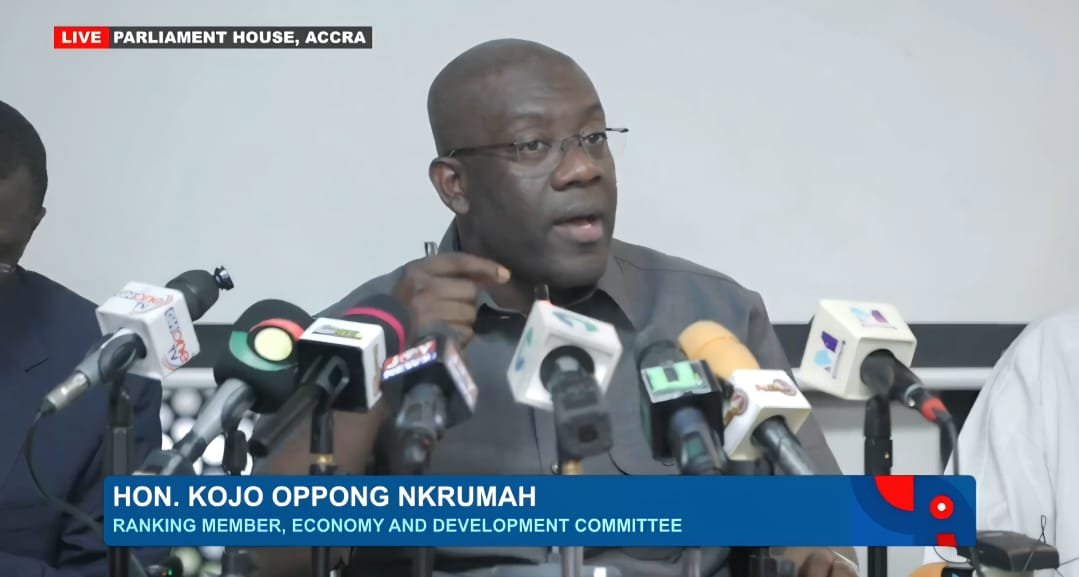
The Member of Parliament for Ofoase-Ayirebi, Kojo Oppong Nkrumah, who led the Minority’s criticism, argued that the government must first account for its existing economic commitments and demonstrate what has been achieved under its previous programmes before introducing another ambitious policy framework.
At a press conference held at Parliament on Tuesday, November 10, 2026, ahead of Finance Minister Dr Cassiel Ato Forson’s presentation of the 2027 Budget, the former Information Minister accused the Mahama administration of giving old promises new names while failing to provide convincing evidence of their delivery.
He described the New Economy policy as a political scam, insisting that Ghanaians deserve more than fresh announcements, impressive financial projections and promises of millions of jobs.
According to Oppong Nkrumah, the central concern is whether the New Economy represents a genuinely new economic programme or simply a rebranding of commitments already announced under the government’s 24-Hour Economy and Big Push initiatives.
President Mahama announced the New Economy policy on August 14, 2026, with a projected investment ambition of US$10 billion over four years. The programme is expected to attract US$2.5 billion annually into seven priority sectors, with agriculture reportedly expected to receive US$5 billion.
However, Oppong Nkrumah questioned the basis of the new investment projections, arguing that the government must explain how the proposed financing differs from earlier commitments and identify the actual sources of funding.
He recalled that the 24-Hour Economy policy was launched on July 2, 2025, following its announcement on June 30, 2025, with an ambition to mobilise US$4 billion over four years and create approximately 1.7 million jobs by 2028.
The Minority believes the introduction of the New Economy policy raises serious questions about the status of the earlier programme, particularly regarding the number of jobs created, the amount of money actually mobilised and the projects that have moved beyond announcements into implementation.
Oppong Nkrumah pointed to statements attributed to the 24-Hour Economy Secretariat indicating that, as of October 19, 2026, it could not yet provide a definitive figure for jobs created under the programme because it was working with the Ghana Statistical Service to establish a measurement framework.
Although four projects have reportedly been associated with projected employment opportunities of about 160,000, the Minority argued that this remains considerably below the original target of 1.7 million jobs.
The former Information Minister also questioned the government’s announcement in July 2026 of US$5.5 billion in project agreements, stressing that signed agreements should not be presented as though the money had already been disbursed or the projects fully operational.
He maintained that Ghanaians need clear information on the difference between investment commitments, signed agreements, actual financial inflows and completed projects.
A major part of Oppong Nkrumah’s presentation centred on what the Minority described as the need for the government to account for approximately GH¢650 billion in public funds it says the administration has received during its first two years in office.
He questioned why, despite the reported volume of public resources available to the government, significant gaps remain between budgetary allocations and actual expenditure on development projects.
The Minority cited capital expenditure figures for 2025, arguing that the government failed to execute a substantial portion of its approved development budget.
According to the figures presented, capital expenditure for January to June 2025 was budgeted at GH¢18.1 billion, but actual spending stood at approximately GH¢7.1 billion, representing a shortfall of about 61 per cent.
For the period between January and September 2025, the capital expenditure budget was GH¢26.6 billion, while actual expenditure was approximately GH¢10.9 billion, leaving a shortfall of about 59 per cent.
The Minority further cited domestic capital expenditure, which it said was budgeted at GH¢15.9 billion for the first nine months of 2025, against actual spending of GH¢7.2 billion.
Oppong Nkrumah argued that these figures raise questions about the government’s ability to translate budgetary promises into actual development activities.
He also drew attention to expenditure performance in 2026, citing total expenditure of GH¢127.2 billion against a budget of GH¢158.6 billion for the first half of the year.
On capital expenditure, the Minority said that against a full-year allocation of approximately GH¢57.5 billion, spending by July 2026 stood at about GH¢24 billion.
The caucus argued that the government must explain why allocations announced in budget statements have not consistently translated into corresponding expenditure and completed projects.
The Minority also questioned the financing arrangements for the government’s Big Push infrastructure programme, particularly the commitments associated with road contracts.
It cited approximately GH¢63 billion in road contracts and compared that figure with combined allocations of GH¢13.8 billion in the 2025 Budget and GH¢30 billion in the 2026 Budget.
According to the figures presented, the combined allocations amount to GH¢43.8 billion, leaving a difference of approximately GH¢19 billion against the stated contract commitments.
Oppong Nkrumah questioned how the outstanding commitments would be financed and whether the government had made adequate provision for the projects it had already announced.
He also raised concerns about the use of petroleum-related funds for infrastructure financing, citing figures which the Minority said showed that the Annual Budget Funding Amount had received only US$1.9 million against an annual ceiling of US$573.1 million by September 2025.
The caucus argued that the government must provide a transparent account of the sources of funding for the Big Push and explain how the New Economy policy will be financed without creating further pressure on public finances.
Oppong Nkrumah argued that the government had made several ambitious job creation promises but had yet to provide a comprehensive and independently verifiable account of the jobs actually created.
He cited the 1.7 million jobs target under the 24-Hour Economy and the projections associated with the Big Push programme, including estimates of hundreds of thousands of employment opportunities from road construction contracts.
The Minority questioned whether the figures being announced represent permanent employment, temporary construction jobs, indirect employment or projections based on economic multipliers.