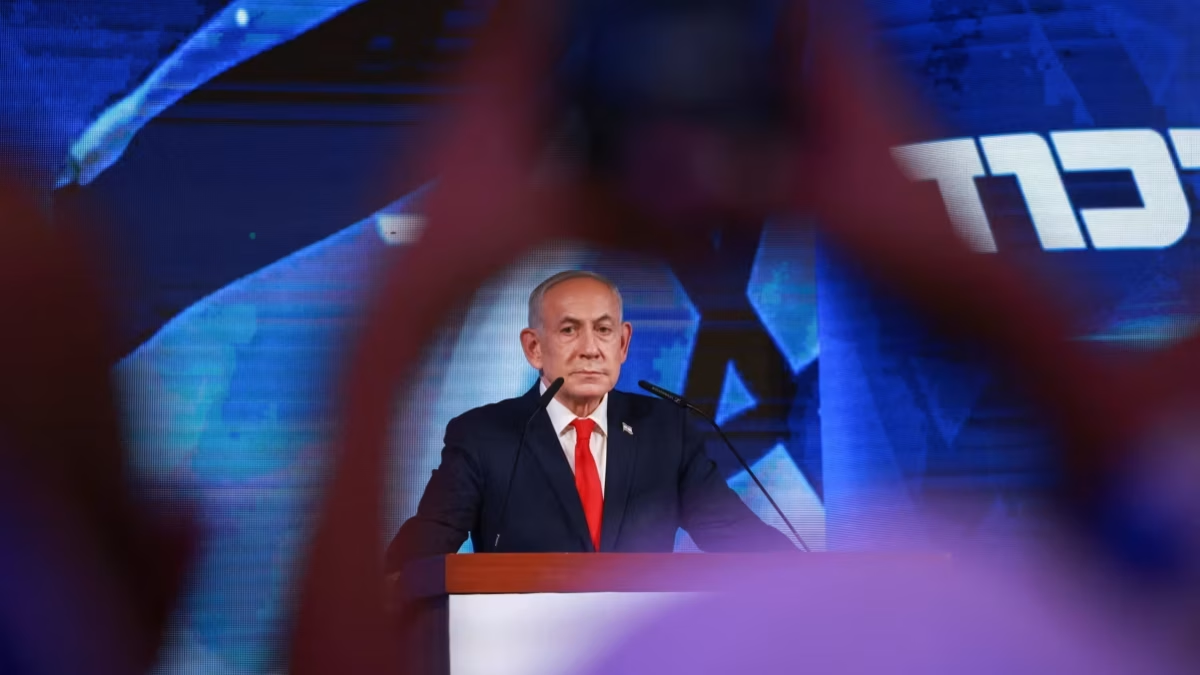
No clear winner has emerged from Israel’s election with all the votes counted, according to the Israeli Central Elections Committee.
Both major political blocs have fallen short of the 61 seats needed to form a majority government in Israel’s 120-seat parliament, called the Knesset, setting up the country for weeks of coalition talks or the possibility of a fresh vote.
Israel Prime Minister Benjamin Netanyahu’s Likud party and its far-right and ultra-Orthodox Jewish allies won 53 seats.
Main opposition candidate Gadi Eisenkot’s Yashar party and three other Jewish opposition parties in his bloc have secured 48 seats.
With an inconclusive result, it could be weeks — possibly months — in which Netanyahu’s survival remains on the line.
In a political career that has spanned more than three decades, Netanyahu has been written off too many times to count, only to prove the obituaries were penned prematurely.
Netanyahu hasn’t won. But he hasn’t lost, either — at least not yet. Now, he has to stop his rivals from building their own government, and he may survive again.
The Arab parties
Arab parties – consisting of the Joint List and Raam – won an unprecedented 19 seats.
Analysts say that record turnout by Arabs or Palestinian citizens of Israel was in part a backlash to four years of a far-right national security minister under whom crime in the Arab community soared, and members of the community have blamed the trend on negligent policing. They have also been affected by a rise in racism following October 7 and Israel’s war in Gaza — and have been highly critical of settler violence, all factors that could have mobilized them to vote.
This is where the math gets complicated. Raam is an Islamist party that draws heavily from Israel’s Bedouin community. Its leader, Mansour Abbas, became the first Arab politician to join an Israeli government following the country’s 2021 election. The Joint List, projected to be the bigger Arab party, combines several smaller parties: the Communist Hadash, secularist Taal and nationalist Balad factions.
On Wednesday, Yair Golan, leader of the left-wing Democrats party, called on his partners to count the Arab parties as part of the bloc, rejecting what he called Netanyahu’s “racist division between Jewish and Arab votes.” The following day, Golan met with Abbas. But two of Eisenkot’s right-wing allies, Naftali Bennett and Avigdor Liberman, have opposed any government that depends on the Arab parties. (They have not issued a statement on the issue since polls closed.)
The Joint List said Wednesday that it was ready for political cooperation and was willing to do “do everything in its power to bring Netanyahu’s rule to an end.”
On Thursday, Eisenkot held separate meetings with both Golan and Bennett, where they discussed “their shared commitment to giving effect to the voters’ mandate without delay,” according to Eisenkot’s party.
What will Netanyahu do?
A source close to Netanyahu said his main post-election goal is to delegitimize and therefore prevent the Jewish-Arab political cooperation that could send him home.
After campaigning against them throughout the election, Likud issued a statement on Thursday calling on the Shin Bet and the police to investigate what it described as “involvement of foreign elements who intervened and bribed voters in favor of the Arab parties.”
The statement came after the Central Elections Committee chair, Supreme Court Deputy Chief Justice Noam Solberg wrote to the Shin Bet director David Zini, requesting an inquiry into “serious suspicions” of foreign funding, adding he could not verify the seriousness of the evidence.
But the Central Elections Committee director general Dean Livne rejected the claims of widespread fraud as baseless, saying in a letter to an opposition lawmaker the vote was “conducted lawfully’ and “there is no basis for allegations of systematic violations of election integrity.”
Source: CNN