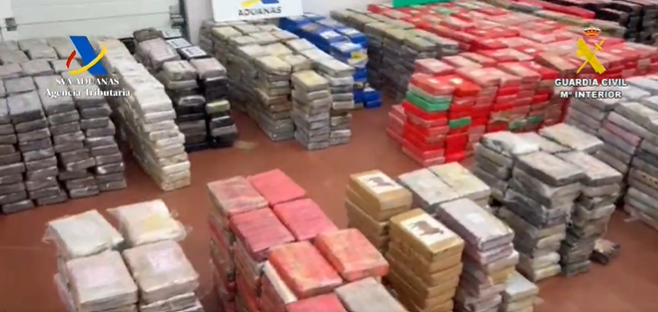
Spanish authorities have seized 2.6 tonnes of cocaine concealed in a shipment of coconuts from Ghana, the latest in a series of major overseas drug interceptions involving consignments traced to the country’s ports.
Two men have been arrested in connection with the consignment after investigators tracked the cargo from the port of Valencia to a warehouse in Almería.
The drugs were hidden in two containers of coconuts loaded at the Tema Port on August 2.
The containers arrived in Valencia 20 days later, where customs officials and the Guardia Civil selected them for inspection after identifying them as presenting a high risk of drug trafficking.
A search uncovered packages of cocaine concealed beneath false bottoms fitted into the wooden crates used to carry the coconuts.
Tests confirmed that the white powder was cocaine.
Investigators removed the drugs but left the containers sealed, allowing them to monitor the cargo and identify those who would eventually take delivery.
Their surveillance led them to two refrigerated lorries that arrived to collect the containers. Officers followed the vehicles to a warehouse at the La Juaida industrial estate in Almería.
The arrests were made as the cargo was being unloaded. Those detained were identified as the suspected importer of the drugs and the person responsible for supervising the unloading.
Spanish authorities released details of the seizure on Wednesday, November 11, 2026.
Another major seizure linked to Ghana
The Spanish operation adds to a growing list of drug interceptions overseas involving shipments dispatched from Ghana.
In September 2026, French customs seized nearly 3.9 tonnes of cocaine concealed in a container carrying plastic waste from Ghana at the port of Dunkirk. The consignment was valued at approximately €225 million, equivalent to about US$261 million.
The seizure triggered investigations in Ghana, with the Narcotics Control Commission (NACOC) announcing the arrest of three suspects. Several other people were subsequently arrested and put before the courts over their alleged roles in the shipment.
The case has drawn attention to the handling of export containers at the Tema Port, after investigations reportedly raised questions about abnormalities detected in scan images before the containers were cleared for shipment.
In another case, a Syrian national was arrested at Beirut’s Rafic Hariri International Airport on October 31, 2026, after arriving from Accra with about 40 kilogrammes of suspected cocaine concealed in two pieces of luggage.
NACOC confirmed the arrest and said it was working with Lebanese authorities to identify and apprehend alleged accomplices in Ghana.
The seizures follow major interceptions in Europe in 2025.
In November that year, Belgian authorities found 2,829 kilogrammes of cocaine concealed in cassava flour shipped from Tema to Antwerp. A further 1,158 kilogrammes of suspected cocaine from Ghana was intercepted at the same port in December.
Earlier, in June 2025, Dutch customs seized 4.5 tonnes of cocaine hidden in a timber consignment from Tema at the Port of Amsterdam. The seizure was reported as the largest in the port’s history at the time.
The problem has also extended beyond cocaine. In June 2026, Australian authorities announced the seizure of 320 kilogrammes of methamphetamine concealed in a charcoal shipment from Ghana.
Ghana’s growing international exposure
The series of interceptions has raised concerns about the use of Ghanaian ports and legitimate export cargo by international drug trafficking networks.
Figures from Belgian customs, reported by JoyNews Research in September 2026, placed Ghana as the fifth-largest country of origin for cocaine seized at the port of Antwerp in 2025. Ghana was the only African country among the five leading countries on the list.
The classification refers to the country from which the cargo was shipped, rather than where the cocaine was produced. The report noted that the drugs were believed to originate from South America and were concealed in legitimate exports.
Again, a JoyNews tally, published in September, counted 28 narcotics-related cases linked to Ghana since January 2025, including 11 involving cocaine. The cocaine seizures with published weights amounted to approximately 15.8 tonnes.
The September seizure in France also prompted President John Dramani Mahama to convene a meeting of security chiefs and direct an inter-agency task force to review the country’s systems for detecting narcotics at ports and borders.
The recurring interceptions have brought renewed scrutiny to cargo inspection, intelligence-sharing and cooperation among agencies responsible for securing Ghana’s ports and international supply chains.
Source: Myjoyonline