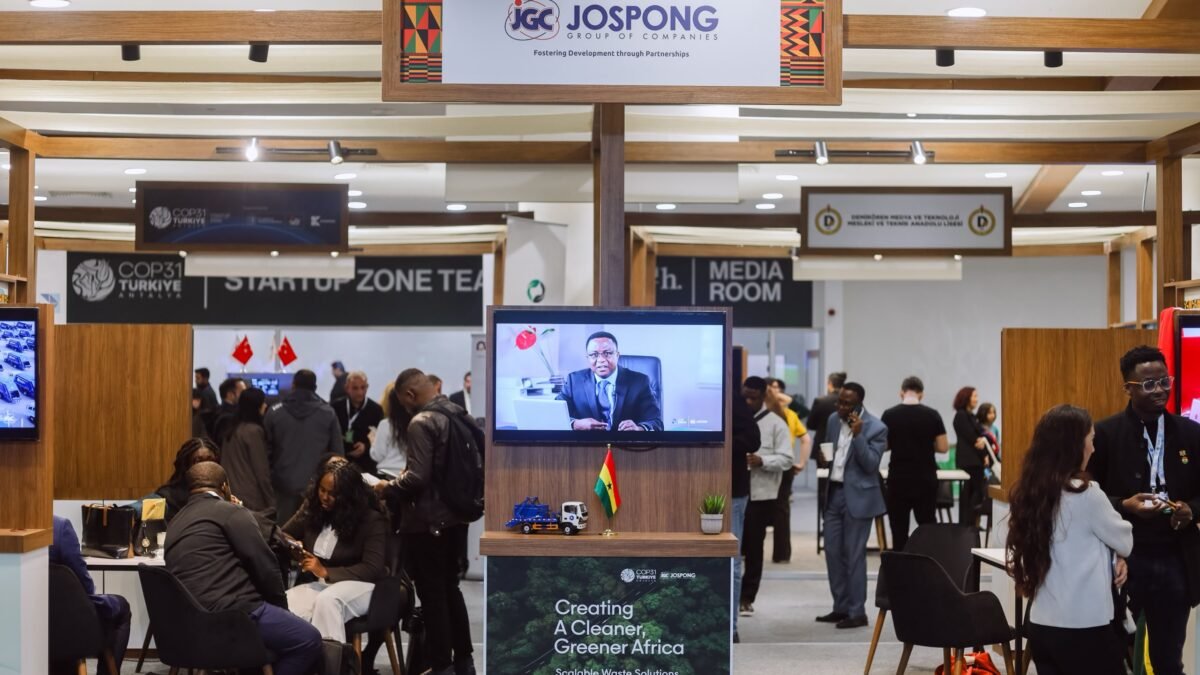
Ghanaian business conglomerate, Jospong Group of Companies (JGC), has made a strong entry at the 31st United Nations Climate Change Conference (COP31) in Antalya, Türkiye, with an ambitious agenda to champion African-led waste management solutions and deepen international partnerships in environmental sustainability.
The conference, which opened on November 9, and is scheduled to conclude on November 20, 2026, has brought together world leaders, policymakers, climate experts, investors and private sector institutions to advance discussions on climate action, sustainable development and green investment.
For Jospong Group, COP31 offers another strategic platform to demonstrate Africa’s capacity to develop practical, innovative and commercially viable responses to its environmental challenges.
The Group’s delegation is led by its Executive Chairman, Dr Joseph Siaw Agyepong, together with senior executives representing subsidiaries and businesses including Zoomlion Ghana Limited, the Integrated Recycling and Compost Plant (IRECOP), Accra Compost and Recycling Plant (ACARP), Asian African Consortium (AAC) and enterprises within its green transition portfolio.
Two messages displayed at the Jospong exhibition booth capture the Group’s vision: “Creating a Cleaner, Greener Africa” and “Scalable Waste Solutions for Growing Cities.” Together, they reflect its determination to place African-developed environmental solutions at the centre of global discussions on climate resilience and sustainable urban development.
RECOP: An African Solution to Africa’s Waste Challenges
At the heart of Jospong’s COP31 engagement is the Integrated Recycling and Compost Plant (IRECOP), a waste-processing model designed to recover value from municipal solid waste while reducing pollution and reliance on conventional landfill disposal.
Developed with the needs of African cities in mind, the IRECOP concept brings together waste sorting, material recovery, recycling and compost production within a coordinated system. It offers rapidly urbanising economies a pathway from traditional waste disposal towards a circular economy in which waste becomes a resource.
Beyond improving sanitation, the model has the potential to generate jobs, attract private investment, support agricultural productivity through compost production and reduce greenhouse gas emissions associated with poorly managed waste.
This African-centred, multi-purpose approach is what Jospong is promoting to governments, municipal authorities, development institutions and investors at COP31.
Expanding Ghanaian Environmental Expertise Across Africa
Jospong’s participation comes as the Group pursues opportunities to extend its environmental services and waste management expertise beyond Ghana. Its expansion ambitions span nearly 30 African countries, with engagements and interests in markets including Nigeria, Kenya, Angola, Liberia, Guinea, The Gambia and Togo.
For countries grappling with rapid population growth, inadequate waste infrastructure, unemployment and increasing environmental pressures, the model offers an opportunity to explore locally relevant waste recovery systems supported by African technical expertise.
The Group hopes to encourage wider investment in integrated facilities that can improve sanitation, recover useful materials and create economic opportunities in growing cities.
From Climate Conversations to Business
Partnerships
Although international climate conferences are best known for policy negotiations and commitments, Jospong is approaching COP31 with a distinctly investment-oriented agenda. It aims to turn high-level engagements into business opportunities, strategic partnerships and agreements that could support the rollout of integrated waste management infrastructure across Africa and beyond.
Through discussions with government delegations, investors and development partners, the Group is seeking to strengthen existing relationships and open new markets for its environmental services and technologies.
Building on International Climate Partnerships
Jospong’s current outreach also builds on its earlier participation in international climate initiatives. At COP28 in Dubai in 2023, representatives of the Group, led by Dr Agyepong, engaged with Switzerland’s Federal Office for the Environment (BAFU), represented by Ambassador Felix Wertli, in connection with a reported €20 million authorisation arrangement relating to internationally transferred mitigation outcomes (ITMOs) from the Group’s integrated recycling and composting facilities.
That earlier engagement illustrates the potential link between waste infrastructure and international carbon-market cooperation. The precise financial terms, authorisation status and resulting carbon-credit transactions should, however, be distinguished when assessing the agreement’s outcomes.
Taking African Innovation to the World
Jospong’s message at COP31 extends beyond showcasing infrastructure. It is also a case for African innovation, investment and technical expertise to play a greater role in the global response to climate change, rather than relying exclusively on solutions developed elsewhere.
As the conference progresses, attention will turn to the partnerships, investment commitments and potential agreements the Group can secure. Its success will ultimately be measured not simply by its visibility in Antalya, but by its ability to translate discussions into projects that deliver cleaner cities, greener economies and sustainable livelihoods.
From Antalya, Jospong is carrying a message of African enterprise and environmental transformation to the world: Africa has solutions to offer, and the time has come to scale them.