A warm welcome in Moscow is not proof that media reports have misrepresented Russia. Neither is justified frustration with Western media dominance a reason to adopt Russian state narratives. Yet the line between the two is blurring, and Ghana sits closer to that line than most.
The Russia-Africa Media Forum, held alongside the third Russia-Africa Summit in Moscow, drew more than 200 participants from 46 African countries. RT organised it with Sputnik and TASS, promoting media sovereignty, professional cooperation, and greater African control over the continent’s image. These are legitimate aspirations. The question is whether Africa is reclaiming its narrative or merely changing the foreign power that shapes it.
Ghana supplied the forum’s most visible test case. In an interview RT published on 28 October, the Ghanaian YouTuber Wode Maya said he had been apprehensive about travelling to Russia, only to find a country different from the one he had imagined. RT’s headline gave his remark a sharper edge: “You won’t believe that I fell for the propaganda.”
There is nothing wrong with a visitor finding that a country differs from its portrayal. Personal experience can puncture stereotypes. But hospitality is not investigation. A pleasant trip cannot tell us whether the invasion of Ukraine squares with Moscow’s professed respect for sovereignty, whether Russian military operations in Africa have made civilians safer, or whether Russian state media cover either question fairly.
Fairness also matters here. Nothing in the material I have seen shows that Maya was paid to promote Russia or misrepresented what he felt, and suggesting otherwise would be wrong. The concern is what happens to a sincere impression once a state-backed broadcaster selects, edits, headlines and distributes it. A travel experience becomes a testimonial, a testimonial becomes a geopolitical narrative, and an influencer’s credibility with African audiences becomes an instrument of international communication.
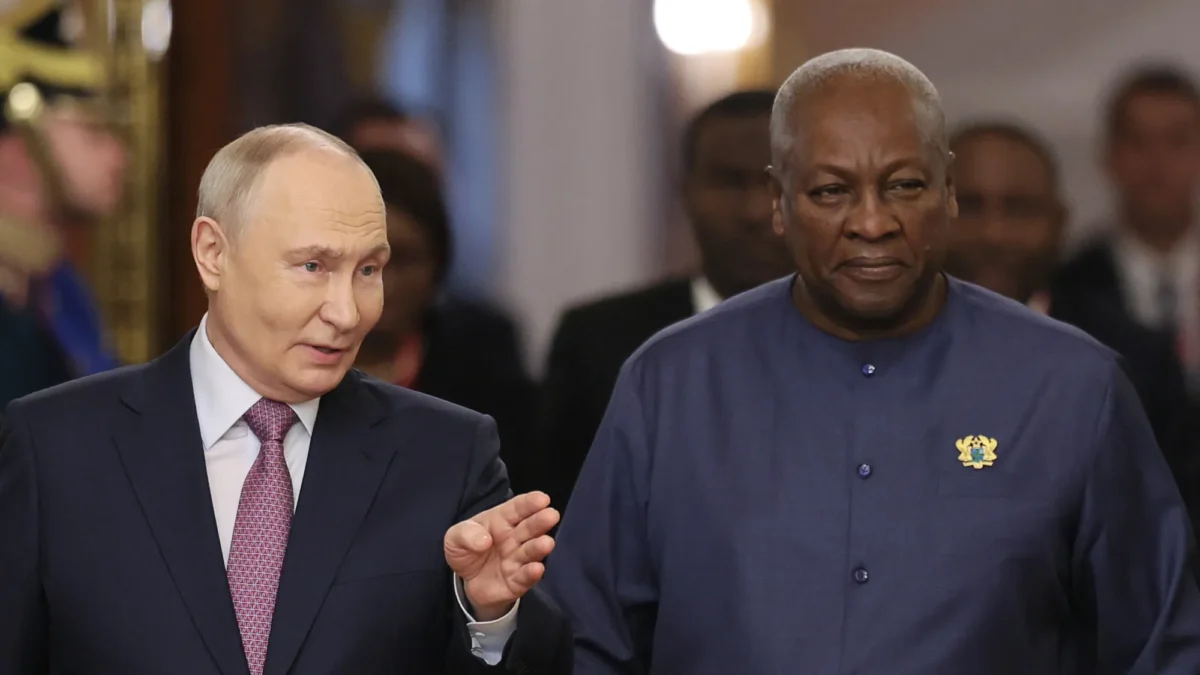
He was not the only Ghanaian voice. President John Mahama, in his own RT interview, said members of his delegation had expected a sanctions-hit economy in ruins and found instead “a cultural shock”. He also said he hoped the war would end quickly, and he pressed the case for Russian investment in agro-processing, fertiliser and pharmaceuticals, which is the substance Ghanaians should care about. Samia Nkrumah, daughter of Ghana’s first president, appeared on an RT panel about the founders of African independence. Each contribution was individually defensible. Together, curated by one broadcaster, they became a Ghanaian chorus.
That history deserves a Ghanaian reading. Kwame Nkrumah’s non-alignment was never an instruction to love one bloc. It was a refusal to be owned by any. A Ghana that honours his legacy engages Moscow, Washington, Beijing and Paris on its own terms and asks hard questions of all four.
“Nkrumah’s non-alignment was never an instruction to love one bloc. It was a refusal to be owned by any.”
Content creators have transformed African storytelling, reaching audiences that traditional newsrooms struggle to attract, and that deserves recognition. But influence is not journalism. Reporting involves verification, context, editorial accountability and a willingness to confront uncomfortable facts. The sensible response is not to discredit creators but to ask for transparency: who sponsored the visit, who paid for travel and accommodation, whether any content was commissioned, and whether the creator retained full editorial control. These are not accusations. They are basic safeguards whenever governments or corporations cultivate influential voices, and they apply to every capital.
The stakes rise when institutional agreements accompany personal testimonials. RT says it has signed cooperation agreements with media organisations in a dozen African countries, including Ghana, Tanzania and Zimbabwe, covering content exchange, training and broadcasting. Ghana Broadcasting Corporation’s agreement with Rossiya Segodnya provides for reciprocal access to English-language news, help for journalists and joint events. GBC’s Director-General, Professor Amin Alhassan, has said it would bring balance to the corporation’s coverage of Russia.
Balance is the right goal, and international news cooperation can widen access and build skills. But a public broadcaster owes viewers clear labelling of foreign state material, independent fact-checking, and the freedom to investigate Russian policy, including the war in Ukraine and Africa Corps operations in the Sahel. The agreement does not by itself establish Russian editorial control. It does demand visible safeguards.
Those safeguards matter more to Ghana than to most other countries. Russia’s media push accompanies its security role in Mali, Burkina Faso, and Niger, and Burkina Faso borders Ghana’s northern neighbour. Jihadist violence in the Sahel has already pressed towards coastal states. Ghanaian audiences need reporting on whether Russian-backed security operations are protecting civilians, and that reporting cannot be outsourced to the partners being assessed.
None of this excuses the other side. France’s colonial-era relationships deserve scrutiny, and so do Western interventions and the stereotypes in international coverage. Nor is Russia alone in courting African audiences: the BBC, France 24, Deutsche Welle and China’s CGTN all run training and content partnerships, and they deserve the same transparency. When allegations against Russian personnel are dismissed as Western propaganda by reflex, journalism gives way to loyalty. When criticism of Moscow is read as service to NATO, the same failure runs in reverse.
A May 2026 report by the Centre for a New American Security says Russia pays journalists and outlets for stories, and that networks of local influencers and journalists amplify Kremlin narratives. CNAS is a Washington think tank; its findings need independent corroboration, and it says nothing about Maya. They do explain why disclosure is not an insult.
The remedy is consistent standards. Broadcasters should disclose content-sharing deals and label supplied material. Journalists and creators should declare sponsored travel and commissioned work. Press associations should sharpen their ethical codes, and governments should protect independent reporting rather than invoking sovereignty to silence it. Above all, Ghana’s newsrooms need investment in investigative capacity and distribution so that no foreign partner becomes necessary.
A warm welcome is not evidence. A foreign partnership is not liberation. Changing the nationality of those who shape Africa’s narrative is not the same as reclaiming it. Media sovereignty is not about choosing whose script to believe. It is about keeping the freedom to question everyone.
The writer: Joseph McCarthy is an analyst and researcher specialising in governance, security and political transitions in the Sahel. He writes on geopolitics, development and African diplomacy. joecarthy30@gmail.com