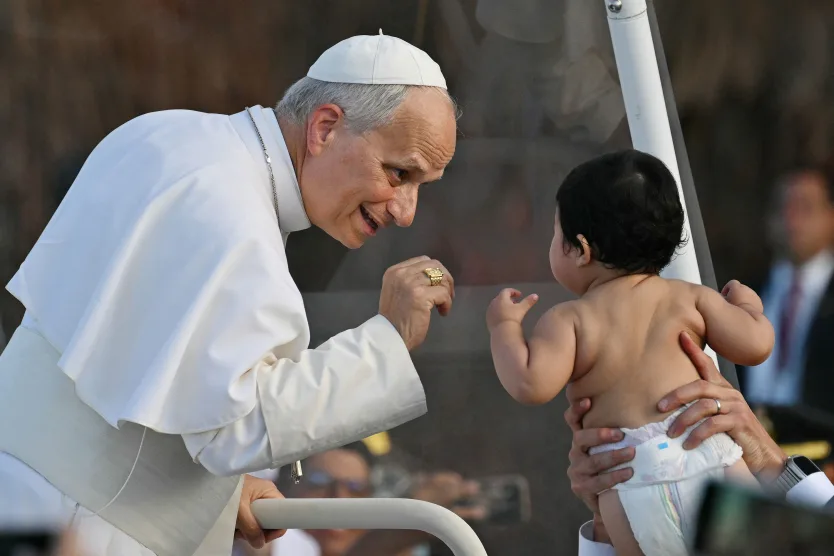
Pope Leo XIV’s visit to South America will go down as one of the lasting images of his papacy.
He drew massive crowds and there was an emotional outpouring over his return to Peru just weeks after having undergone lung cancer surgery.
Leo XIV’s trip has dispelled, for now, any lingering questions about his health, as he kept up a dizzying schedule of events over the 12-day visit with dozens of speeches and events.
It also showed how comfortable Leo has been in a continent where he spent a large chunk of his adult life.
A pope with dual identities
The pope was visibly moved when he sang the Peruvian national anthem on his arrival in Lima and was seen wiping away tears during a gathering of young people in the national stadium.
Outside of the Vatican, and in a place he calls home, the pope seemed relaxed and far less scripted. He would frequently speak off-the-cuff to the people who gathered outside the different papal embassies where he stayed during his trip.
He was even able to stay in his former home in Chiclayo, at the bishop’s residence in the northern city in Peru where he once served as a bishop. The trip to Peru also highlighted how the Chicago-born pontiff balances dual identities.
As we flew out from Rome to Uruguay’s capital Montevideo with Pope Leo XIV, I asked him about his recent decision to cast a vote in the US midterm elections, a decision which surprised some in the Vatican given the pope is a head of state.
“I’m proud to be an American,” he replied. “And to exercise the right [to vote].”
His latest foreign tour, however, has seen him emphasize his Peruvian identity with people in Peru seeing “Papa Leon” as one of their own.
“¡El papa es peruano!” (The Pope is Peruvian) was frequently chanted during his time in the country where he spent around two decades as a missionary and bishop.
When Rev. Robert Prevost was appointed Bishop of Chiclayo it was a requirement he became a citizen, and the pope continues to hold citizenship. “The Peruvian people are my people too,” he said during the final mass of his tour at Las Palmas Airbase in Lima, before boarding a plane to Rome on Monday.
His decision to vote in the US midterms, and make it known, sent a message about the importance of voting, and his support for democracy. He emphasized this message in Argentina, with the pope urging President Javier Milei to safeguard democracy and to adopt a “careful use of words.”
It’s a message with wider resonance in Latin America, where the pope has witnessed firsthand the fragility of democracy.
Arriving in Peru, he was greeted by President Keiko Fujimori, the daughter of the disgraced late President Alberto Fujimori, who was convicted of authorizing the operation of a death squad in his country.
As a missionary in Peru, he witnessed then President Alberto Fujimori dissolve congress and suspend the constitution along with grave human rights violations. In 2017, Prevost criticized Alberto Fujimori’s pardon, saying that the former president’s apology had been too generic for the victims of his regime.
While Catholic Church in the past has been skeptical and hostile to democracy, the first American pope is becoming one of its most prominent defenders.
Enormous crowds
Leo drew huge crowds during his time in South America. More than 12 million people were estimated to have turned out for papal events and masses in Uruguay, Argentina and Peru.
In the Argentine capital Buenos Aires, he presided over the largest Mass of his pontificate with around 2.5 million people in attendance, and 3 million lined the streets of the Peruvian city of Lima for his return, according to Vatican estimates provided by local authorities.
Source: CNN